
Propeller diameter and blade length: how to size it
The diameter of a propeller is twice the radius at the blade tip, and it sets the area the rotor sweeps as it turns. The larger the propeller, the more fluid it acts on, and the better its efficiency is likely to be. Sizing the diameter, and therefore the blade length, means finding how far to grow before meeting three limits: the speed of sound at the blade tip, centrifugal force and, in water, cavitation.
In this page:
- Propeller diameter and swept area: definition
- Setting the diameter and blade length in Heliciel
- Why a larger propeller performs better
- First limit: blade tip speed
- Second limit: centrifugal force
- Third limit: cavitation, ventilation and immersion
1 : Propeller diameter and swept area: definition
The diameter D is twice the radius R measured from the axis of rotation to the blade tip. The area swept by the rotor, or propeller area, follows from it:
D = 2 × R and A = π × R² = π × D² / 4
where D is the diameter (m), R the radius at the blade tip (m) and A the swept area (m²). The area grows as the square of the diameter: doubling the diameter quadruples the area. Choosing the right diameter, and therefore the right blade length, requires knowing what role this area plays in our system.
2 : Setting the diameter and blade length in Heliciel
In Heliciel, you impose the blade length: the radius at the blade tip is entered in the 2: Blade geometry tab, 2.1: Blade dimensions sub-tab. Heliciel displays the corresponding diameter, and the blade root radius is set as a proportion of the tip radius.
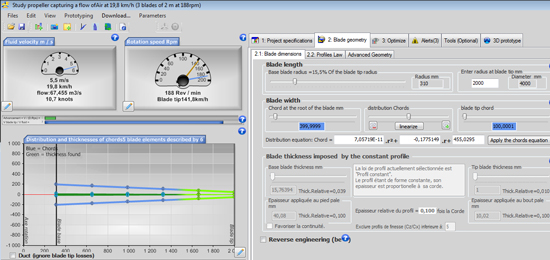
The « 2.1: Blade dimensions » tab: the « Blade length » group gives the blade root radius (as a percentage of the tip radius), the radius at the blade tip in millimetres and the resulting diameter.
The diameter is a value you impose. If you do not know where to set it, the genetic search can explore the blade tip radius, between the bounds you set, together with the speed and the number of blades. The root radius is sized separately: see blade root radius.
3 : Why a larger propeller performs better
To keep it simple, we could say that the larger the propeller, the better. But why, and up to what limit? Three pages of the site answer, depending on the type of propeller:
- the role of blade or wing length in tip leakage: wing, hydrofoil and sail;
- the role of blade length in wind turbines, water turbines and other driving propellers: energy-capture propeller;
- the role of blade length in boat propellers, aircraft propellers and other propulsive propellers:
- the propulsion propellers page introduces the notion of tip leakage, by recalling the origin of the propulsive force;
- the propulsive efficiency of the propeller is determined by the diameter before any construction; during construction, we monitor this parameter.
We generally reach the same conclusion: the larger the propeller, the better its efficiency. But diameter and blade length create constraints that must be taken into account. When there is no room to enlarge the propeller, a propeller shroud reduces tip losses without increasing the diameter.
4 : First limit: blade tip speed
The longer the blade, the higher its speed at the tip. For a propeller turning at n revolutions per second, the blade tip travels a circle of circumference π × D on each turn:
vtip = π × D × n
where vtip is the blade tip speed (m/s), D the diameter (m) and n the rotation speed (rev/s). At constant speed of rotation, the tip speed is proportional to the diameter.
Hypothetical example: a propeller 1.50 m in diameter turns at 2,400 rpm, that is 40 rev/s. Its blade tip moves at π × 1.50 × 40 ≈ 188 m/s, before even adding the forward speed. With the same speed of rotation and a 2 m diameter, the tip would reach about 251 m/s.
For propellers operating in air, the speed of sound (about 340 m/s at 15 °C) is a limit that cannot be exceeded without destroying the performance of the propeller. Compressibility effects are felt even before reaching it, and Heliciel's calculation method is valid only at subsonic speeds: see the propeller calculation method. We therefore stay well below the speed of sound. The choice of rotation speed is discussed on the page about propeller rotation speed.
5 : Second limit: centrifugal force
Centrifugal force can become considerable at the blade tip. For a mass m at radius R it is:
F = m × vtip² / R
With the previous example (R = 0.75 m, vtip ≈ 188 m/s), each kilogram at the blade tip is pulled with a force of about 47 kN, nearly 4,800 times its weight. The strength of the blade must therefore be assessed against its rotating mass. Heliciel offers this check: see the blade strength in bending and centrifugal tension.
6 : Third limit: cavitation, ventilation and immersion
For a propeller operating in water, cavitation depends on lift, which depends on the speed seen by the blade element, and therefore on the tangential speed, which is high at the tip of large-diameter blades. Cavitation and ventilation (air drawn in from the surface) also appear more easily at shallow depth.
To keep the blades from cavitating or ventilating as they approach the surface, the shaft must be deeply immersed. A large blade length can therefore raise installation difficulties. Heliciel takes the depth into account in the 3: Optimize tab, through the cavitation detection parameter, the test depth in millimetres.
To go further, we can see how the rotation speed and number of blades are chosen once the diameter is fixed, or how to choose the number of blades of a propeller.
 Global site map
 Mecaflux
 Tutorials Mecaflux Pro3D
 Tutorials Heliciel
 Tutorials Heliciel PRO CFD
 Mecaflux Store
 Compare software functions
 Quotes, Orders, Payment Methods
 project technical studies